Foshan Mingjun Textile Company Ltd.

Views: 0 Author: Site Editor Publish Time: 2025-11-14 Origin: Site
You may ask, what is a dvt sock? This sock is made to help your legs. It gently squeezes your legs to help blood move better. Each year, many people get deep vein thrombosis (DVT). DVT means blood clots form in veins. The table below shows how often DVT happens in the world:
Source | Notes | |
|---|---|---|
Servier | 76.6 | Lower-extremity DVT without pulmonary embolism each year |
eMedicine | 1.92 per 1000 person-years | Age-standardized rate of first-time VTE |
MSJ Online | 1 in 1,000 | Estimated yearly rate in the USA (about 350,000 cases) |
Wearing DVT socks helps you in many ways:
You lower your risk of blood clots when you travel far.
You can have less swelling and pain in your legs.
You help your veins and keep your legs comfy.
DVT socks gently squeeze your legs. This helps blood move better and lowers the chance of blood clots.
These socks help people who might get deep vein thrombosis. They are good for people who had blood clots before or can't move much.
Graduated compression means the socks are tightest at your ankle. This helps push blood up toward your heart.
Wearing DVT socks on long trips or after surgery can lower your risk of getting DVT.
There are different levels of compression. Ask your doctor to pick the best socks for you.
DVT socks can help with leg swelling, pain, and tiredness. They are great for people who sit or stand a lot.
Make sure your socks fit well. They should feel tight but not hurt.
Using DVT socks often can help you heal after surgery. They also keep your legs healthy.
You may wonder, what is a dvt sock? This special sock is designed to help your veins work better. DVT socks, also called compression stockings or compression socks, fit tighter than regular socks. You wear them to gently squeeze your legs. This gentle pressure helps blood move from your feet back to your heart. When blood flows well, you lower your risk of deep vein thrombosis, which means you are less likely to get blood clots in your veins.
Compression stockings use graduated compression. This means the sock is tightest at your ankle and gets looser as it goes up your leg. This design helps stop blood from pooling in your veins. You get better blood flow, less pain, and less swelling in your legs. If you sit or stand for long periods, you may notice your legs feel tired or heavy. Compression socks can help you feel more comfortable.
Tip: If you have swelling, pain, or a history of blood clots, ask your doctor about what is a dvt sock? You may need compression stockings to protect your veins.
Here is what a dvt sock can do for you:
Improve blood flow in your veins
Reduce pain and swelling in your legs
Lower your chances of getting dvt
You may ask, what is a dvt sock? Is it different from other compression stockings or compression socks? DVT socks are a type of compression stockings made for medical use. They focus on preventing dvt and helping your veins stay healthy. Some compression socks are made for sports or travel, but dvt socks are designed for people at risk for blood clots.
Here is a table that shows the differences:
Feature | DVT Socks | Standard Compression Stockings |
|---|---|---|
Intended Use | Specifically for DVT prevention and treatment | General support for various conditions |
Design | Graduated compression tailored for medical use | May not be tailored for DVT prevention |
Medical Applications | Focused on medical conditions like DVT, chronic venous insufficiency | Broader range including sports and travel |
You use dvt socks when you need to protect your veins from blood clots. Compression stockings for sports or travel may not give you the same medical benefits.
When you look for what is a dvt sock?, you find different types and lengths. Compression socks and compression stockings come in many styles. You can choose knee-high stockings, thigh-high, or pantyhose styles. Each type helps your veins in a different way.
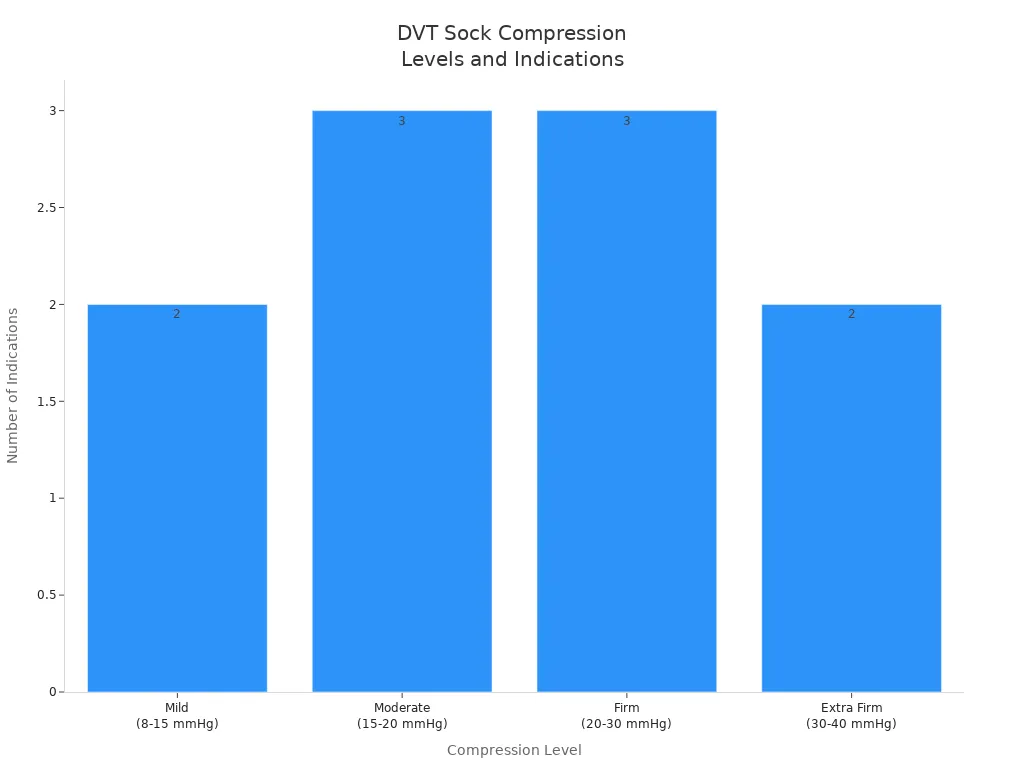
Compression levels also matter. You pick the right level based on your needs. Here is a table that explains the types and their uses:
Compression Level | Indications |
|---|---|
Mild (8-15 mmHg) | Light support for minor swelling and fatigue. |
Moderate (15-20 mmHg) | Prevents dvt, mild varicose veins, and swelling during travel. |
Firm (20-30 mmHg) | Recommended for moderate swelling, varicose veins, and post-surgical recovery. |
Extra Firm (30-40 mmHg) | Used for severe venous disorders and advanced cases of dvt or PTS. |
Lengths | Available in knee high, thigh high, and pantyhose styles. |
You may need knee-high stockings if you have mild swelling. If you need more support, you can choose thigh-high or pantyhose styles. Compression socks and compression stockings help your veins by giving the right amount of pressure. You should ask your doctor which type is best for you.
Note: Always check with a healthcare provider before you start using compression socks or compression stockings. Your doctor can help you choose the right style and compression level for your veins.
Graduated compression means that compression stockings and compression socks squeeze your legs with different strengths. The strongest pressure starts at your ankle. The pressure slowly gets lighter as the sock goes up your leg. This design helps your veins push blood upward, fighting gravity. You get the most help where your veins need it most.
Compression stockings apply the highest pressure at your ankle.
The pressure gets lighter as the sock moves up your leg.
This pressure gradient helps blood move up toward your heart.
Compression socks act like an extra muscle, helping your calf squeeze your veins.
Compression socks and compression stockings use graduated compression to support your veins. The tight fit at your ankle helps close your veins and move blood up. As the sock gets looser higher on your leg, your veins keep pushing blood toward your heart. This process helps improve blood flow and keeps blood from pooling in your legs.
Note: Compression socks help your veins work better by giving the right amount of pressure where you need it.
When you wear compression stockings, your veins get extra support. The socks squeeze your veins gently, making them smaller. This action increases blood flow speed and volume. Your legs feel less tired, and you have less swelling. Compression socks help restore normal circulation and reduce pain.
Healthy blood flow keeps your veins working well. If blood moves slowly or pools in your veins, you risk getting deep vein thrombosis. Compression socks and compression stockings help improve blood flow, making it harder for clots to form. You lower your risk of dvt when your veins stay active.
DVT socks use graduated compression to help your veins. The socks squeeze your legs in a way that helps blood move up. Your veins get support, and blood does not pool. Compression socks and compression stockings help prevent swelling and pain, keeping your veins healthy.
You may have poor circulation if you sit or stand for long periods. Other risk factors include surgery, injury, or certain medical conditions. DVT socks and compression stockings help your veins by improving blood flow and reducing your risk of dvt.
DVT socks and compression stockings use graduated compression to keep blood moving. The socks help your veins push blood up, lowering the chance of clots. Compression socks make it harder for blood to pool, which helps prevent clots from forming.
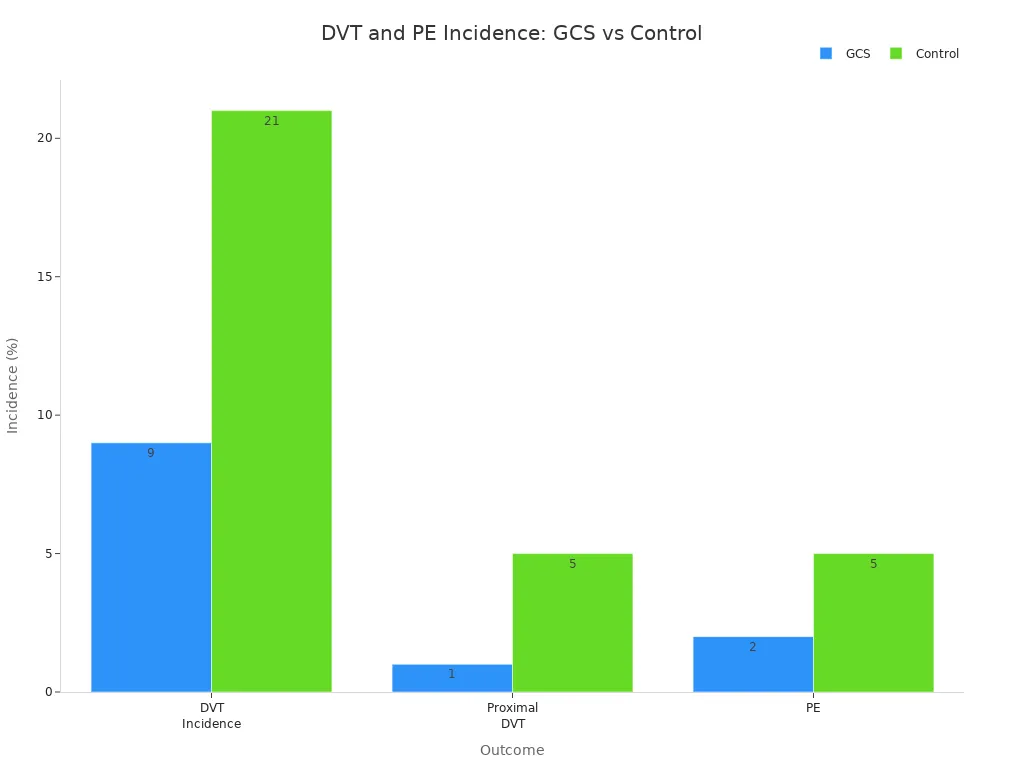
Compression socks work best when you wear them during travel, after surgery, or when you must sit or lie down for a long time. Studies show that compression stockings reduce the risk of dvt and blood clots in these situations.
Group | Total Units | Odds Ratio (OR) | 95% Confidence Interval (CI) | P-value | |
|---|---|---|---|---|---|
GCS | 134 of 1445 (9%) | 1445 | 0.35 | 0.28 to 0.43 | < 0.001 |
Control | 290 of 1408 (21%) | 1408 | N/A | N/A | N/A |
Proximal DVT (GCS) | 7 of 517 (1%) | 517 | 0.26 | 0.13 to 0.53 | < 0.001 |
Proximal DVT (Control) | 28 of 518 (5%) | 518 | N/A | N/A | N/A |
PE (GCS) | 5 of 283 (2%) | 283 | 0.38 | 0.15 to 0.96 | 0.04 |
PE (Control) | 14 of 286 (5%) | 286 | N/A | N/A | N/A |
Compression socks and compression stockings help many people, but they do not work for everyone. You should talk to your doctor before using dvt socks, especially if you have certain health problems. Compression may not be safe for people with severe artery disease or skin issues. Always check for a good fit and follow your doctor’s advice.
Tip: Compression socks help prevent dvt, but you must use them correctly and choose the right type for your veins.
You can lower your risk of dvt by wearing compression stockings. These socks squeeze your legs and help your veins move blood back to your heart. When blood moves well, blood clots are less likely to form. Studies show that compression socks reduce the risk of dvt in people who need extra protection. Here are some important findings:
Patients using compression stockings had a much lower risk of dvt. The odds ratio was 0.10, which means the risk dropped by 90%.
The number of people who got dvt fell from 3% to 0.3% when they wore compression socks.
For high-risk groups, you need to treat only 37 people with compression stockings to prevent one case of dvt.
Compression socks help your veins work better. The gentle pressure from compression stockings improves blood flow and keeps your legs healthy. You get more support for your veins, which helps prevent dvt. When you wear compression socks, you help your veins push blood up and away from your feet. This action helps improve blood flow and keeps your legs feeling strong.
If you have a higher chance of getting dvt, you need extra protection. Compression stockings give you that support. People who have had blood clots before, those with certain medical conditions, or those who stay in bed for long periods benefit most. You can lower your risk of dvt and pulmonary embolism by using compression socks. Your veins stay healthy, and you feel safer.
Compression socks help reduce swelling in your legs. The pressure from compression stockings keeps fluid from building up. Your veins get support, and your legs stay comfortable. Clinical trials show that compression socks can reduce swelling after surgery. Look at the table below:
Study Focus | Findings |
|---|---|
Impact of compression stockings on leg swelling after arthroscopy | Significant reduction in post-operative limb swelling when wearing compression stockings compared to not wearing them. This may enhance rehabilitation after surgery. Optimal duration of use is between three and ten days. |
You may feel pain or heaviness in your legs if you sit or stand for a long time. Compression socks help your veins move blood, which reduces pain. You get relief from discomfort, and your legs feel lighter. Compression stockings make it easier for your veins to do their job.
Compression socks help you feel less tired. Your veins get support, and blood moves better. You notice less heaviness and fatigue in your legs. Compression stockings help you stay active and comfortable. You can reduce swelling and pain with regular use.
After surgery, your veins need help to move blood. Compression socks give your veins the support they need. Studies show that compression stockings lower the risk of dvt after surgery. You heal faster and feel better.
Patients using graduated compression stockings had fewer cases of dvt than those who did not.
Compression socks increase blood flow speed and reduce the chance of blood clots.
Not using compression stockings raises your risk of dvt by more than two times.
Combining compression socks with other treatments can lower dvt risk after pelvic surgery.
Compression socks help your veins recover after injury or illness. You get better blood flow, and your legs heal faster. Compression stockings support your veins and keep blood moving. You feel less pain and swelling.
You want to get back to your daily life quickly. Compression socks help your veins work well, so you recover faster. Guidelines recommend compression stockings for most surgical patients until they can move around again. You improve blood flow and support your veins, which helps you return to normal activity sooner.
You may spend hours sitting on a plane, riding in a car, or lying in bed after surgery. Your legs can feel heavy, swollen, or sore. DVT socks help you stay comfortable during these times. The socks use graduated compression, which means they squeeze your ankles the most and get looser as they move up your legs. This design helps your blood flow back to your heart. You lower your risk of blood pooling and deep vein thrombosis (DVT).
DVT socks give gentle, steady pressure. You feel less discomfort when you wear them for long trips or bed rest. The socks help your veins work better, so you do not get as much swelling or pain. You can relax and know your legs have extra support.
Tip: Put on your DVT socks before you start your journey or settle into bed. You will notice your legs feel lighter and less tired.
You may work at a desk, study for school, or watch TV for hours. Sitting for long periods can make your legs feel stiff or achy. DVT socks help you stay comfortable even when you do not move much. The socks provide firm but gentle pressure, starting at your ankle and easing up your leg. This pressure helps your veins push blood upward.
You can use DVT socks every day if you have a sedentary lifestyle. The socks keep your legs from feeling heavy or sore. You may notice less swelling at the end of the day. Your legs stay healthy, and you feel more energized.
Here are some ways DVT socks help you at home or work:
Reduce swelling and pain after sitting for hours.
Keep your legs feeling fresh and comfortable.
Support your veins and improve blood flow.
You may feel stiff or sore in your legs after sitting or lying down for a long time. DVT socks help prevent these problems. The graduated compression keeps your blood moving, so your muscles and veins get the oxygen they need. You feel less stiffness and soreness.
DVT socks work like a gentle massage for your legs. The pressure helps your body remove waste and extra fluid. You can stretch and move more easily when your legs feel good. If you use DVT socks regularly, you may notice you recover faster from long periods of inactivity.
Note: DVT socks do not replace movement. Try to stand up and stretch when you can. The socks give you extra comfort and protection when you cannot move as much.
You can trust DVT socks to help your legs stay comfortable, healthy, and strong during times when you must sit or rest for long periods.
If you want to protect your veins and lower your risk of dvt, you should know who benefits most from DVT socks. Some groups have a higher chance of developing dvt because their veins do not move blood as well.
You may need DVT socks if you have had blood clots before. Your veins can struggle to keep blood moving, which increases your risk of dvt. DVT socks help your veins push blood upward, lowering the chance of another clot.
If you have a clotting disorder or a family history of dvt, your veins may form clots more easily. DVT socks give your veins extra support and help prevent dvt from returning.
Pregnancy and childbirth can slow blood flow in your veins. You may notice swelling or discomfort. DVT socks help your veins move blood better, reducing the risk of dvt during and after pregnancy.
As you get older, your veins may weaken. DVT socks help your veins work harder to keep blood moving. This lowers your risk of dvt and keeps your legs healthy.
If you have a chronic illness that limits movement, your veins may not push blood as well. DVT socks help your veins stay active, lowering your risk of dvt.
Group at Risk | Benefit from DVT Socks |
|---|---|
Hospitalized Patients | Yes, especially those undergoing surgery |
Moderate to High-Risk Surgical Patients | Yes, to prevent dvt |
Long periods of sitting or lying down can slow blood flow in your veins. DVT socks help your veins keep blood moving, even when you cannot walk much.
If you travel on long flights, your veins may not move blood well. Up to 10% of long-haul airline travelers develop symptomless dvt. Wearing DVT socks can lower this risk. Studies show that none of the passengers who wore compression stockings developed dvt.
You may sit for hours on a trip. Your veins can slow down, and dvt risk goes up. DVT socks help your veins push blood upward, keeping your legs safe.
If you sit at a desk or watch TV for long periods, your veins may get sluggish. DVT socks support your veins and help prevent dvt.
When you stay in bed for days, your veins need help. DVT socks keep blood moving and lower your risk of dvt.
Wearing compression stockings reduces the chance of symptomless dvt (odds ratio 0.10, 95% CI 0.04 to 0.25, P < 0.001).
Certain surgeries and health problems can make your veins more likely to form dvt. DVT socks play a key role in prevention.
After surgery, your veins may slow down. DVT socks apply pressure to your veins, helping blood flow upward and limiting swelling.
Major surgery can increase dvt risk. DVT socks help your veins move blood and prevent pooling.
If your heart or veins do not work well, blood can pool in your legs. DVT socks help your veins push blood up, lowering dvt risk.
Cancer and its treatments can slow blood flow in your veins. DVT socks support your veins and help prevent dvt.
If you stay in the hospital for a long time, your veins may need extra help. DVT socks improve blood flow and lower your risk of dvt.
Compression socks are tightest around the ankle and become less tight toward the knee. This design helps your veins limit swelling and move blood upward, fighting gravity. You can prevent blood clots and serious problems like pulmonary embolism by wearing DVT socks after surgery or during illness.
Major surgery (abdomen, pelvis, hip, or legs)
Fractures or severe muscle injury
Bed confinement or limited movement
Previous blood clot or inherited disorder
Family history of blood clots
Overweight, age 55+, hormonal medications
Recent pregnancy, cancer treatment, or other medical conditions
DVT socks help your veins stay healthy and lower your risk of dvt in these situations.
You need to choose the right compression strength. Compression stockings come in different levels. Mild compression (15-20 mmHg) helps stop mild swelling. Use it if you sit or stand a lot. Moderate compression (20-30 mmHg) helps with tired legs and varicose veins. Firm compression (30-40 mmHg) is for bad swelling or vein problems. Extra firm compression (40-50 mmHg or more) is only for very serious cases. You need a doctor’s note for extra firm socks.
Mild compression: Stops mild swelling.
Moderate compression: Helps tired legs and varicose veins.
Firm compression: Treats bad swelling and vein problems.
Extra firm compression: For very serious vein diseases.
Compression stockings come in different lengths. Knee-highs are good for daily use and small swelling. Thigh-highs help if your veins have problems above your knee. Compression pantyhose cover your legs and waist. They help with very bad vein problems. The table below shows the types and what they do:
Type of Compression Stocking | Description |
|---|---|
Graduated Compression Stockings | Tightest at the ankle, looser at the top, good for many vein problems. |
Anti-Embolism Stockings | For people who can’t move much, gives steady pressure. |
Compression Pantyhose | Covers both legs and waist, best for very bad vein problems. |
Compression Knee-Highs | Covers lower leg, easy to wear, good for daily use. |
Compression Thigh-Highs | Goes up to the thigh, best for big vein problems. |
Pick compression stockings that feel nice and work well. Merino wool keeps feet dry and comfy all year. Alpaca is soft and warm. Bamboo fiber lets your feet breathe and soaks up sweat. Nylon and spandex are stretchy and keep socks from slipping.
Material | Properties |
|---|---|
Merino Wool | Breathes, keeps feet dry, fights germs, works in any season. |
Alpaca | Strong, warm, and very soft for comfort. |
Bamboo Fiber | Soft, lets feet breathe, soaks up sweat, fights germs, and has bright colors. |
Nylon and Spandex | Tough, stretchy, gives gentle squeeze, stops slipping and bunching for comfort all day. |
Talk to your doctor before you pick compression socks. Your doctor can help you choose the right strength and length. A healthcare worker will check your veins and tell you which socks are best for you.
You need to measure your legs to get the right size. Measure your bare legs in the morning before they swell. Use a soft tape to measure your ankle and calf. Stand with your legs apart and relaxed.
Measure in the morning for best results.
Use a soft tape close to your skin.
Write down your ankle and calf sizes.
Look at the sizing chart for your compression stockings. Each brand has different sizes. Good measurements help you find the best fit and make sure the socks work.
A good fit feels snug but not painful. Compression socks should not bunch up or leave deep marks. If socks hurt or make your feet numb, you need a new size.
If your legs swell during the day, measure again and change your size. You may need a new size if your legs change shape because of sickness or injury.
Make sure your legs are dry before you put on socks. Turn the sock inside out, match your heel, and smooth the fabric so it does not bunch up.
Start by wearing compression socks for short times. Wear them longer as you get used to them. Keep more than one pair to stay clean.
Wash compression stockings in cool water. Read the label for washing tips. Hang them to dry and store them flat in a cool, dry place.
Wash after each use or every 3-5 wears.
Do not use a dryer so the socks stay strong.
Get new compression socks every 3 to 6 months. Look for signs like loose stretch or lost shape. Fresh socks give you the best support.
Tip: Taking care of your compression stockings helps them work well and keeps your legs healthy.
You should put on compression stockings in the morning, right after you wake up. Your legs are usually less swollen at this time. Wearing them early helps stop swelling before it starts. Most people wear compression stockings during the day when they are up and moving. You do not need to wear them while you sleep unless your doctor tells you to. Wearing compression stockings during waking hours gives your veins the most support.
You get the best results when you wear compression stockings for most of the day. Many doctors suggest wearing them for about 8 hours, which matches a normal workday. Some studies show that wearing compression stockings for 10 hours can help even more with swelling than just 6 hours. You may need to adjust the time based on how your legs feel or what your doctor says. You should wear compression stockings every day if you have vein problems or if you are at risk for blood clots. Take them off at night to let your skin rest.
Tip: Put on your compression stockings before you start your daily activities. This helps keep swelling and pain away.
You may need to wear compression stockings in special situations. If you travel for a long time by plane, car, or train, wear compression stockings to help your blood flow. If you have surgery or must stay in bed, compression stockings can lower your risk of blood clots. Doctors often recommend compression stockings for people who have just had surgery or who cannot move much. You should also use compression stockings if you have sudden swelling or pain in your legs. Always follow your doctor’s advice for these situations.
Situation | When to Wear Compression Stockings |
|---|---|
Long Travel | During the entire trip |
After Surgery | As directed by your doctor |
Bed Rest | While you are not moving much |
Sudden Swelling | Until your doctor says to stop |
You should not wear compression stockings if your doctor tells you not to. Some people with severe artery disease, skin infections, or open wounds should avoid compression. If you notice pain, numbness, or color changes in your legs, take off the compression stockings and call your doctor. Do not wear compression stockings at night unless your doctor says it is safe. Always check your skin for redness or sores when you use compression stockings.
Note: If you feel any new pain or see changes in your skin, stop using compression stockings and get medical help.
You should talk to your doctor before using DVT socks. DVT socks can cause skin problems or hurt your legs if they do not fit right. If you have a health problem like chronic venous insufficiency or deep vein thrombosis, you need to make sure compression socks are safe for you. Your doctor can check your veins and help you pick the best socks.
You should ask your doctor if you:
Already have vein problems
Notice signs of poor blood flow
Have peripheral arterial disease
After you start wearing DVT socks, pay attention to your legs. Your doctor may want to see how you are doing. If you notice new problems, call your doctor. Regular checkups help keep you safe and make sure the socks work well.
If you have diabetes, heart issues, or other long-term illnesses, you need extra care. Compression socks may not be good for everyone. Your doctor can help you decide if DVT socks are safe for you. Always listen to your doctor’s advice.
Kids and older adults need special care with DVT socks. Their skin can be sensitive, and their veins may work differently. Ask your doctor before using compression socks for children or seniors.
Watch for signs that DVT socks may not be right for you. If you see any of these problems, stop using the socks and call your doctor.
Sign | What to Look For |
|---|---|
Swelling (Edema) | Swelling in your feet, ankles, or legs that gets worse during the day. |
Skin Changes | Redness, color changes, or sores near the sock line. |
Pain or Heaviness | Aching, heavy feeling, or numbness in your legs after standing or walking. |
Persistent Sock Marks | Deep marks that stay even when you wear loose socks. |
If you feel more pain after putting on DVT socks, take them off. Pain can mean the socks are too tight or not right for you.
Watch for numbness or tingling in your legs. These signs can mean your socks are stopping blood flow. If you lose feeling, remove the socks and call your doctor.
Check your skin for color changes or sores. Redness, bruises, or open wounds near the sock line are bad signs. Stop using the socks and get help from your doctor.
If you see swelling below the sock, your blood may not be moving well. This can mean the socks are too tight or do not fit right.
Look for itching, rash, or bumps where the sock touches your skin. These signs can mean you are allergic to the sock material. Stop wearing the socks and talk to your doctor.
Tip: Check your legs and feet every day when you use DVT socks. If you see warning signs, act fast.
Some health problems mean you should not use DVT socks. Your doctor can help you know if compression socks are safe for you.
Contraindication | Description |
|---|---|
Decompensated cardiac insufficiency | Compression is not safe for people with this heart problem. |
Severe peripheral arterial occlusive disease (PAOD) | Main reason to avoid DVT socks. |
Severe diabetic neuropathy and microangiopathy | Compression treatment is not recommended for these conditions. |
If you have severe peripheral arterial disease, do not use DVT socks. Compression can make blood flow worse in your legs.
People with advanced peripheral neuropathy should not use compression socks. Nerve problems can make it hard to feel pain, which is risky.
Do not wear DVT socks over open wounds or skin infections. Compression can make these problems worse.
If you are allergic to certain sock materials, pick a different type or do not use DVT socks.
Compression is not safe for people with severe heart failure. Your doctor can help you find other ways to protect your veins.
Note: Always ask your doctor before you use DVT socks if you have any of these problems. Your safety is most important.
You can keep your legs safe by wearing DVT socks. These socks help stop swelling and pain in your lower legs. They also make your legs feel less heavy. Studies show graduated compression stockings lower the risk of DVT and pulmonary embolism, especially for people in hospitals. The table below shows that using graduated compression stockings with intermittent pneumatic compression lowers risk even more:
Intervention | DVT Risk Reduction | D-dimer Level Reduction |
|---|---|---|
GCS alone | Baseline | Baseline |
GCS + IPC | Big drop (P = 0.0002) | Big drop (P = 0.0005) |
DVT socks work best when you use them the right way.
Ask your doctor if you have questions or health worries.
Taking care of your veins helps you stay active and feel good.
You can keep your legs healthy. Make good choices and ask for help if you need it.
You may need DVT socks if your legs swell, feel heavy, or if your doctor says you have a higher risk for blood clots. Ask your doctor for advice before you start using them.
You can wear DVT socks during the day. Most people put them on in the morning and take them off before bed. Your doctor may tell you how long to wear them.
DVT socks should feel snug but not painful. If you feel pain, numbness, or tingling, take them off and talk to your doctor. A good fit helps you stay comfortable.
Wash DVT socks in cool water by hand or on a gentle cycle. Hang them to dry. Do not use a dryer because heat can damage the socks.
You can buy mild or moderate compression socks at stores or online. For firm or extra firm compression, you need a prescription from your doctor.
DVT socks use graduated compression to help blood flow. Regular socks do not squeeze your legs or help prevent blood clots.