Foshan Mingjun Textile Company Ltd.

Views: 0 Author: Site Editor Publish Time: 2026-04-08 Origin: Site
If you want to know how much does it cost to make socks in 2026, the average price is about $2.50 for each pair. Some pairs cost only $1 if you buy simple styles in large quantities. Premium socks with special materials or made in small batches can cost more than $5 each. When you choose MINGJUN Hosiery, you get a trusted partner who cares about quality and being eco-friendly. You receive real value in every pair you make.
The average cost to make socks in 2026 is $1 to $5 per pair. The price changes based on style and materials. Buying many pairs at once makes each pair cheaper. It is smart to order more socks at one time. Basic socks cost less money. Premium and custom socks cost more because of special materials and designs. The material you pick changes the cost. For example, organic cotton and recycled fibers cost more. These materials are also better for the environment. Labor costs are different in each region. This changes the total price of socks. Skilled workers help make socks high quality. MINGJUN Hosiery has flexible pricing models. You can choose what fits your needs and budget. Automation in factories helps lower mistakes and costs. This makes socks better quality. Sustainable socks may cost more at first. But they attract buyers who care about the environment.
If you ask how much does it cost to make socks in 2026, you need to think about a few things. The average cost to manufacture socks is between $1 and $5 for each pair. Most sock manufacturers say the average cost is about $2.50 per pair. This price changes depending on the material, design, and how many pairs you order. If you want to know how much does it cost to manufacture socks for basic styles, the price is lower. Premium or custom socks cost more per pair.
You should know the main parts that make up the cost to manufacture socks. Here is a table that shows the usual cost breakdown:
Cost Component | Description |
|---|---|
Material Costs | Depends on fabric; cotton costs $2-$4 per pound, premium materials can be $8-$12 per pound. |
Manufacturing Equipment | Knitting machines cost $20,000-$50,000, plus extra for finishing and quality checks. |
Labor and Production Costs | Labor can be $0.20 per pair in some countries, but $1-$2 per pair in others. |
Design and Development | Unique designs cost $500-$2,000 each, with extra fees for custom work. |
Overhead Expenses | Overhead adds $0.50-$1.50 per pair, based on production size and location. |
The cost to manufacture socks is not just about materials. Making socks also needs labor, machines, and overhead. Each step in making socks adds to the total cost.
The cost to produce a pair of socks changes with the type you pick. Basic socks use simple materials and designs. Athletic socks need extra things like cushioning or fibers that keep feet dry. Premium socks use special yarns or advanced knitting. Here is a quick comparison:
Basic Socks: These cost $1 to $2 per pair. They have simple designs and regular materials.
Athletic Socks: These cost $2 to $3.50 per pair. You pay more for features and durability.
Premium Socks: These cost $3.50 to $5 or more per pair. They have luxury materials, advanced designs, and extra comfort.
Order size also changes the cost to manufacture socks. If you order a lot, you get a better deal. This means the cost per pair goes down when you buy more. The table below shows how order size affects cost:
Order Size | Average Order Value (AOV) | Cost per Pair Reduction |
|---|---|---|
Large | Lower because of economies of scale |
If you buy in bulk, you pay less per pair. Small orders cost more per pair since fixed costs are spread over fewer socks.
Customization also affects the cost to make socks. Adding custom branding, complex designs, or special packaging makes production cost go up. Here are some things that change the final price:
Factor | Impact on Cost |
|---|---|
Design Complexity | Complex designs need more work and time, so costs go up. |
Order Quantity | Bigger orders usually mean lower cost per sock because of economies of scale. |
Custom Branding Elements | Custom branding raises costs, like woven labels versus paper tags. |
Labor Costs | More detailed designs and custom features mean higher labor costs. |
Shipping and Taxes | Shipping choices and import taxes can make final costs much higher. |
If you want to know how much does it cost to make socks with custom features, expect to pay more than for regular socks.
MINGJUN Hosiery uses flexible pricing to give you the best deal. The company knows every customer has different needs. You can pick from several pricing models based on your order and design. Here is how MINGJUN Hosiery sets prices for different socks:
Type of Socks | Pricing Strategy | Description |
|---|---|---|
Basic Custom Socks | Cost-Plus Pricing | Add a markup to the production cost to stay profitable and competitive. |
Complex Custom Socks | Value-Based Pricing | Set prices based on value, focusing on quality and unique features for higher prices. |
Bulk Orders or Subscription Packages | Special Pricing | Give discounts for big orders or subscriptions to encourage more buying. |
Limited Edition or Exclusive Collections | Premium Pricing | Sell these as high-end products, charging more because they are rare. |
Custom Socks with Special Add-Ons | Combination Pricing | Use both value-based and cost-plus pricing for base costs and extra services. |
You can work with MINGJUN Hosiery to find the right mix of quality and price. The company gives clear quotes and helps you understand how much does it cost to manufacture socks for your needs. If you want to lower your cost to manufacture socks, order more pairs or choose simpler designs. MINGJUN Hosiery’s advanced manufacturing and efficient production help keep prices low, even for custom orders.
Tip: To get the best price per sock, plan your order size and design early. This helps you control the cost to manufacture socks and get the most value for your money.
Image Source: pexels
The material you pick changes how much socks cost. Some fibers are more expensive than others. Look at the table below to see the price differences:
Fiber Type | Cost Level |
|---|---|
Luxury Fibers (Cashmere, Silk) | Most Expensive |
Expensive | |
Basic Naturals (Cotton) | Moderate |
Performance Synthetics (Nylon) | Moderate |
Basic Synthetics (Polyester) | Least Expensive |
Mixing costly fibers with cheaper ones can help save money. Some socks need special treatments, like antimicrobial finishes or extra washing. These treatments make socks cost more to produce. Sustainable fibers, like organic cotton or recycled polyester, usually cost more than regular ones.
Tip: Picking the right fiber helps you get good socks for your budget. Polyester is a smart choice if you want to save money. Cashmere or merino wool will cost more if you want fancy socks.
MINGJUN Hosiery uses eco-friendly materials for their socks. You can get socks made from organic cotton, recycled polyester, bamboo, and other green fibers. The company has certifications like GRS, OEKO-TEX®, and SMETA. These show the socks meet tough rules for the environment and ethics.
Organic cotton socks are soft and let your feet breathe.
Recycled polyester socks help cut down on waste and save energy.
Bamboo socks feel comfy and keep feet dry.
Wool socks from good sources are warm and last a long time.
You can count on MINGJUN Hosiery for socks that help the planet. They use packaging that breaks down naturally and make socks in earth-friendly ways. When you buy these socks, you help the environment.
The fiber you choose changes how much each sock costs. Eco-friendly fibers often cost more because they are harder to get and need special certificates. For example, organic cotton socks cost more because of organic farming and certification fees. Recycled fibers can also raise the price, but they give more value and attract buyers.
Many brands, like EcoSox and Patagonia, use green materials. These brands charge more for socks made with bamboo, organic cotton, or recycled fibers. You pay more at first, but these socks last longer and support good causes.
Note: If you want to spend less, pick basic synthetics. If you want to help the planet, choose organic or recycled fibers. MINGJUN Hosiery can help you find the best mix of price and caring for the earth.
Image Source: unsplash
It is important to know how labor changes the cost to make socks. Workers do many jobs in a sock factory. They join toes, check if socks are good, finish hard designs, pack socks, and watch machines. Labor is about 10-20% of the total cost. If workers get paid more, socks cost more to make. You can see the main ideas in this table:
Aspect | Details |
|---|---|
Labor Cost Percentage | 10-20% of total cost, but rising wages increase absolute costs. |
Historical Wage Increase | From $150/month to $450-$600/month over two decades. |
Key Labor Tasks | Linking toes, quality inspection, complex finishing, packing, machine supervision. |
Skilled workers help keep socks high quality. They make sure every sock is good before it leaves the factory.
MINGJUN Hosiery uses new machines to make socks faster and better. These machines help lower mistakes and save time. Here are some ways automation helps:
The Automated Lady Pant Making Machine has smart sensors and watches the process in real time. The machine can change quickly and keep things running well.
These machines mean less hand work and fewer mistakes. Socks are made faster and still look good.
Automated knitting machines make detailed designs very fast. They use materials well and make less waste.
If you pick MINGJUN Hosiery, your socks are made with the newest technology. This keeps the cost of each sock low, even for special designs.
You should think about where your socks are made. Labor costs are different in each country. In some places, workers get paid more, so socks cost more to make. In other places, workers get paid less, so socks cost less. Even with lots of machines, skilled workers are still needed to check and fix things. This means where socks are made changes the final cost. If you want to save money, look at where your socks will be made.
Tip: Ask your manufacturer about labor costs in their area. This helps you plan your sock order and control your spending.
You need good machines and a nice building to make socks. New knitting machines cost from $20,000 to $50,000 each. You also need other tools for finishing, packing, and checking quality. These extra tools cost between $10,000 and $30,000. Renting a building costs $2,500 every month. Utilities start at $450 and add about 15% of what you earn for overhead. You pay around $1,675 each month for utilities and overhead. If you want to run a sock factory, you must plan for these costs.
Modern knitting machines: $20,000–$50,000 each
Finishing, packaging, quality control equipment: $10,000–$30,000
Facility rent: $2,500 per month
Utilities and overhead: $1,675 per month (includes $450 fixed utility base)
Remember, these costs are needed to make socks well and keep them high quality.
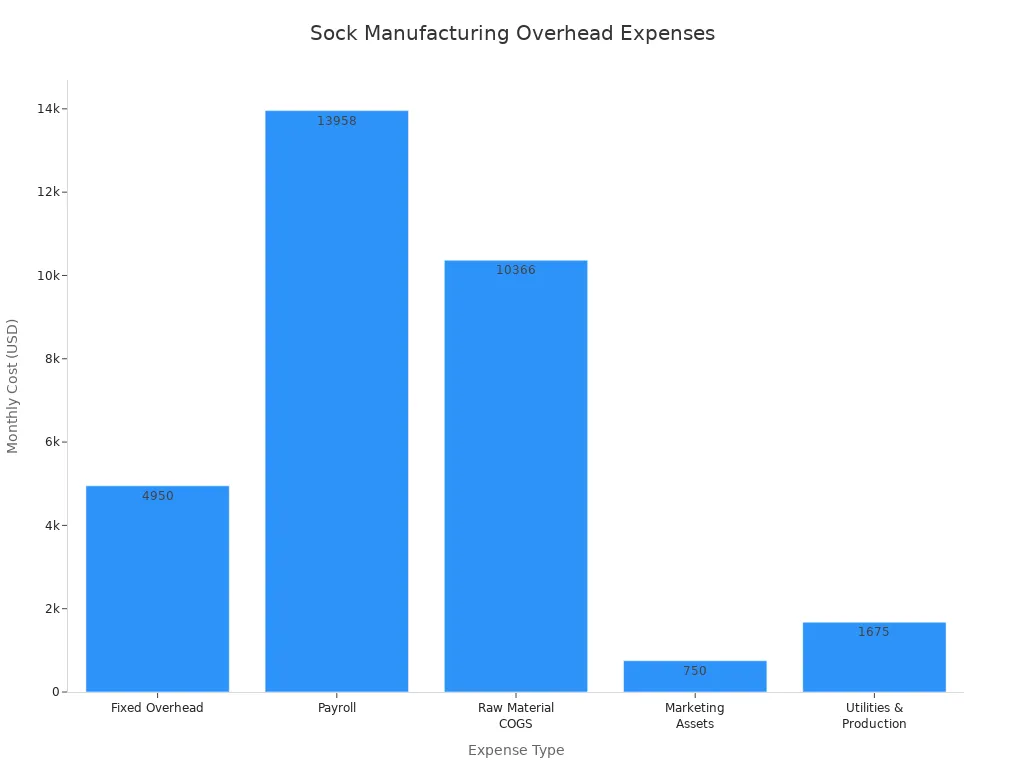
Overhead costs cover many things when making socks. You pay for fixed overhead, worker pay, materials, marketing, and utilities. These costs add up every month. Look at the table below to see the main overhead expenses:
Expense Type | Monthly Cost |
|---|---|
Fixed Overhead | $4,950 |
Payroll | $13,958 |
Raw Material COGS | $10,366 |
Marketing Assets | $750 |
Utilities & Production | $1,675 |
You can see that most money goes to worker pay and materials. Utilities and overhead are smaller but still matter. You need to watch these costs to keep your sock business making money.
Tip: Watch your overhead costs closely. This helps you run your sock business well and avoid problems.
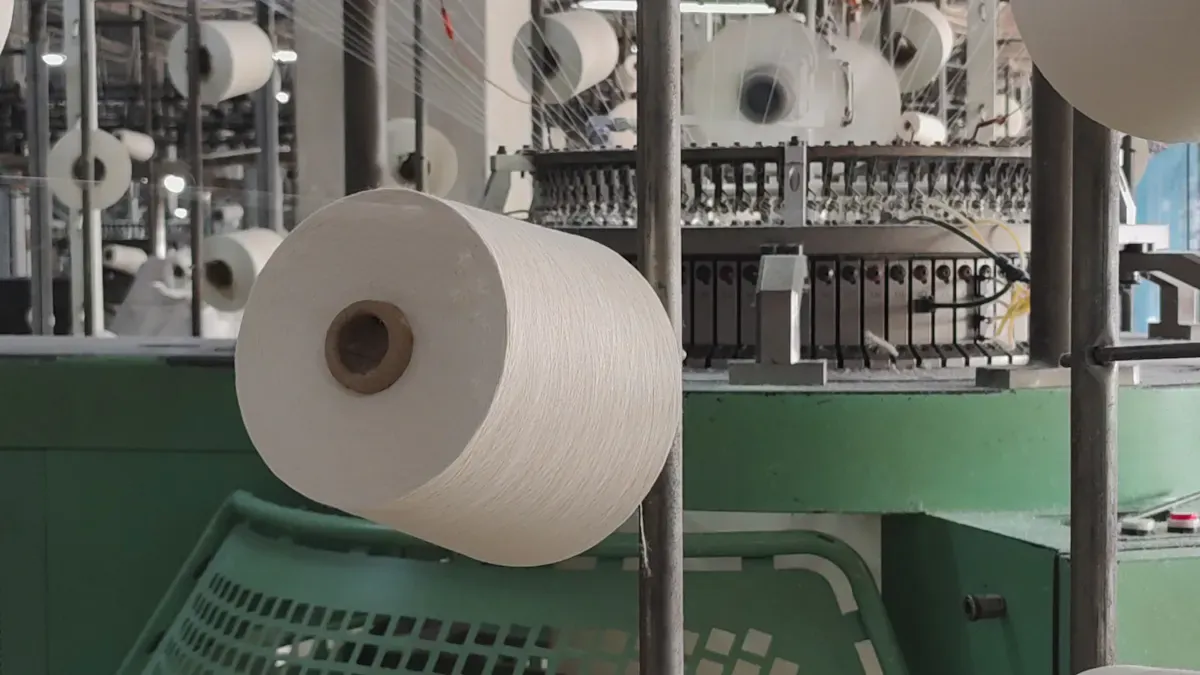
MINGJUN Hosiery uses new machines and a modern building to make socks. You get socks made by fast knitting machines that work very well. The factory uses machines for finishing and packing. This means fewer mistakes and faster work. MINGJUN Hosiery keeps costs low by using smart machines and good layouts. You get socks made in a clean and tidy place. The company checks every sock to make sure it is good. You can trust MINGJUN Hosiery to give you socks that look nice and last long.
Note: When you pick MINGJUN Hosiery, your socks are made in a place that cares about quality and working smart. This helps you get the best value for your money.
If you want to make your socks special, the price can change a lot. Plain socks that you order in big amounts usually cost less than $2 each. But if you add fancy designs or cool features, the price can go over $5 for each pair. Custom designs need more work, like detailed knitting or adding logos and patterns. Most companies want to keep socks high quality, which can make them cost more. When you order just a few socks, setup and design costs are split between fewer pairs, so each sock costs more. If you order a lot, these costs are shared, so each sock is cheaper.
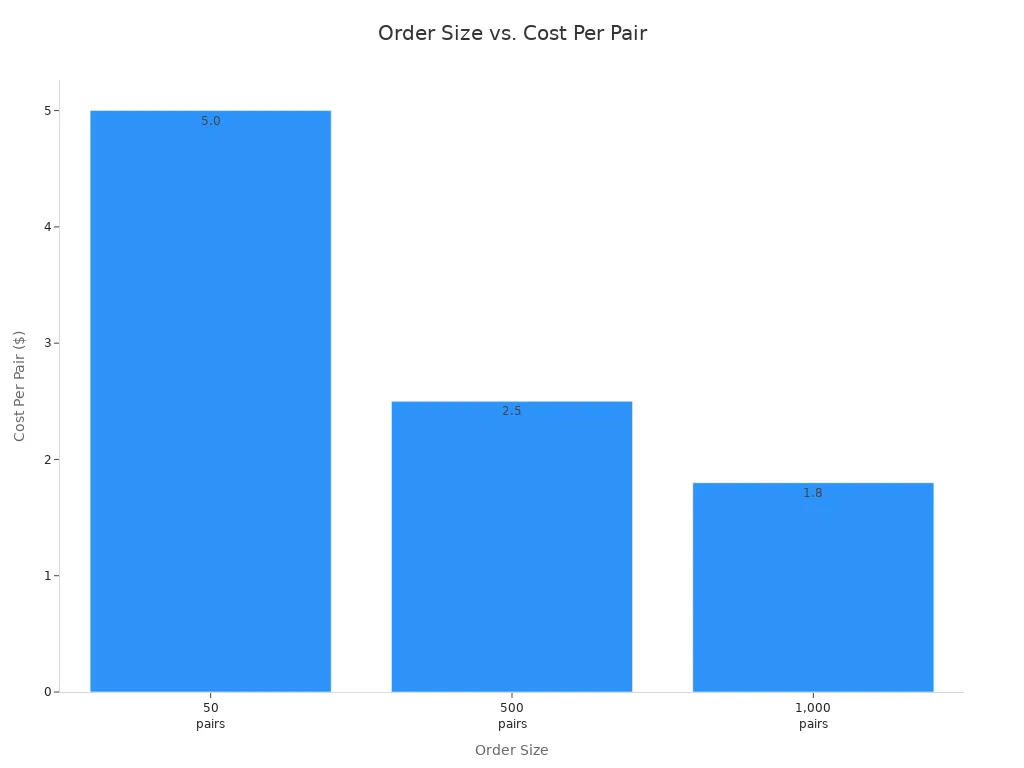
How many socks you order really matters for the price. For example, if you only get 50 pairs, the setup and material costs are high for each sock. But if you order 500 or even 1,000 pairs, the price for each sock goes down a lot. Here is a table that shows how the number of socks you buy changes the cost:
Order Size | Setup Cost Impact | Material Cost | Total Per Pair |
|---|---|---|---|
50 pairs | High | High | $5.00 |
500 pairs | Low | Medium | $2.50 |
1,000 pairs | Very Low | Low | $1.80 |
The chart shows that buying more socks makes each pair cost less. Small orders are more expensive because setup and design costs are split between fewer socks. If you want to save money, it is smart to order more socks at once.
MINGJUN Hosiery lets you pick from many custom options. You can order a small group of special socks or a big batch for a team or company. If you want things like logos, special colors, or fancy patterns, the price will go up, especially if you order only a few. But MINGJUN Hosiery uses a fast and smart way to make socks, so even custom socks can be a good deal.
Many things change how much socks cost. Material prices can go up or down. Labor rates also affect the price. If you order more socks, each sock costs less. Special designs or custom features make socks cost more. Factories use machines to make socks faster. This helps lower the cost. Shipping and taxes can make socks cost more. Delays in the supply chain mean socks take longer to arrive. These delays can raise costs too. You should think about all these things before making socks.
Driver | Effect on Cost |
|---|---|
Material Prices | Higher prices mean higher costs |
Labor Rates | More pay means more expensive socks |
Order Size | Bigger orders lower cost per pair |
Customization | Special features raise price |
Automation | Machines help reduce cost |
Shipping & Taxes | Can increase total cost |
Supply Chain Delays | Longer delivery and higher costs |
Tip: Plan your order early. Pick your materials carefully. This helps you keep costs low and get socks on time.
Market trends can change sock prices quickly. Cotton prices went up by 15% in 2023. This made it harder for factories to keep prices low. Prices for cotton and synthetic fibers go up and down. This changes how much you pay for socks. Labor and material costs went up by 10% last year. Shipping delays made delivery take 12 days longer around the world. These changes show why sock prices can change fast.
Cotton prices went up by 15% in 2023.
Prices for cotton and synthetics affect how much socks cost.
Labor and material costs went up by 10% last year.
Shipping delays made delivery take 12 days longer worldwide.
You need to watch market trends to keep your sock business strong. If prices go up, you may need to change your plans or try new materials.
Eco-friendly socks help the planet but cost more. Organic cotton socks cost 15-25% more than regular cotton socks. This is because organic cotton is harder to grow and needs certification. Recycled polyester makes each pair cost 5-12% more. Bamboo lyocell raises production costs by 20-35%. Eco-friendly packaging adds $0.10 to $0.50 for each sock. Custom socks with sustainable materials can cost $0.50 to $3.00 more per pair. Many buyers pay extra for socks that protect the environment. You can balance these costs by selling to people who care about the planet.
Sustainable Feature | Cost Increase |
|---|---|
Organic Cotton | 15-25% higher |
Recycled Polyester | 5-12% higher |
Bamboo Lyocell | 20-35% higher |
Eco Packaging | $0.10-$0.50 per unit |
Custom Sustainable Socks | $0.50-$3.00 per pair |
Note: Choosing sustainable socks helps the planet. It also attracts buyers who care about the environment.
You will likely pay between $1 and $5 for each pair of socks in 2026. The price depends on things like materials, labor, design, and how many you order. MINGJUN Hosiery is known for making good socks, caring about the environment, and being flexible with orders. When picking a sock manufacturer, you should think about these things:
Good materials and strong designs
Easy-to-understand prices and helpful support
Trustworthy production and good customer reviews
If you pay attention to these things, you will get better socks.
You pay between $1 and $5 for each pair. Basic socks are cheaper than custom or premium socks. The price changes if you pick special materials or order more pairs.
You can pick cotton, polyester, wool, bamboo, or recycled fibers. Each one changes how comfy, strong, or pricey the socks are. MINGJUN Hosiery has eco-friendly choices for people who want green socks.
If you buy more socks, each pair costs less. Small orders are more expensive because setup and design costs are split between fewer socks. Buying in bulk helps you save money.
Yes, you can put your logo, colors, or patterns on socks. Custom socks cost more, especially if you order just a few. MINGJUN Hosiery helps you make special socks for your team or event.
It usually takes 10 to 15 days to make socks. If you need them fast, rush orders take 3 to 5 days. The time depends on how hard the design is and how many you order. MINGJUN Hosiery can finish orders quickly if you need them soon.
Sustainable socks cost 15% to 35% more than regular socks. You pay extra for things like organic cotton, recycled fibers, and green packaging. Many people buy these socks to help the environment.